I remember noticing a painting at the Tate Gallery in London. It was a large canvas, completely white, except for a small black circle on the lower right corner. It struck me as the ultimate middle finger to the viewer: ‘This is art because I say it is’.
I don’t know what made me look more closely, but I shuffled nearer and squinted the way you do when you’re admiring the brush strokes on a Cezanne. Up close I could just make out more faint circles on the lower right, and I suddenly realized what the artist had done. The whole long process of the painting was now clear; the artist had laid down a black circle on the upper left and then glazed the whole canvas with translucent white. Then he’d placed a second circle beside the first and repeated the glazing. He’d done this maybe fifty times, building up layers of glaze until he reached the last black circle on the right and he’d left it unglazed. You could just barely see the black circles along the bottom edge of the painting as they disappeared beneath successive white glazes.
When I was a kid in Scotland I lived a few doors up from my best friend. His father worked for a company that used paper, a publisher I think, and he would bring home reams of beautiful white paper. It’s the sort of sight we’re used to now—great blocks of neatly packed white sheets which we feed into our home printers. Then it must have been extraordinary. Who else would have had great stacks of pure white, unlined paper? My friend and I used the sheets to draw on: tanks and planes mostly, because in Edinburgh we were surrounded by the detritus of war.
There’s something about that expanse of white paper; it’s at once pure, bright and somehow, deep. It invites our trespass. You may have felt the urge facing a field of new snow: the wish to drag your feet across the landscape leaving tracks. I have a suspicion that the only people who make snow angels are characters in romantic Christmas movies, but that’s the same sort of impulse I suppose—to imprint ourselves on the virginal surface.
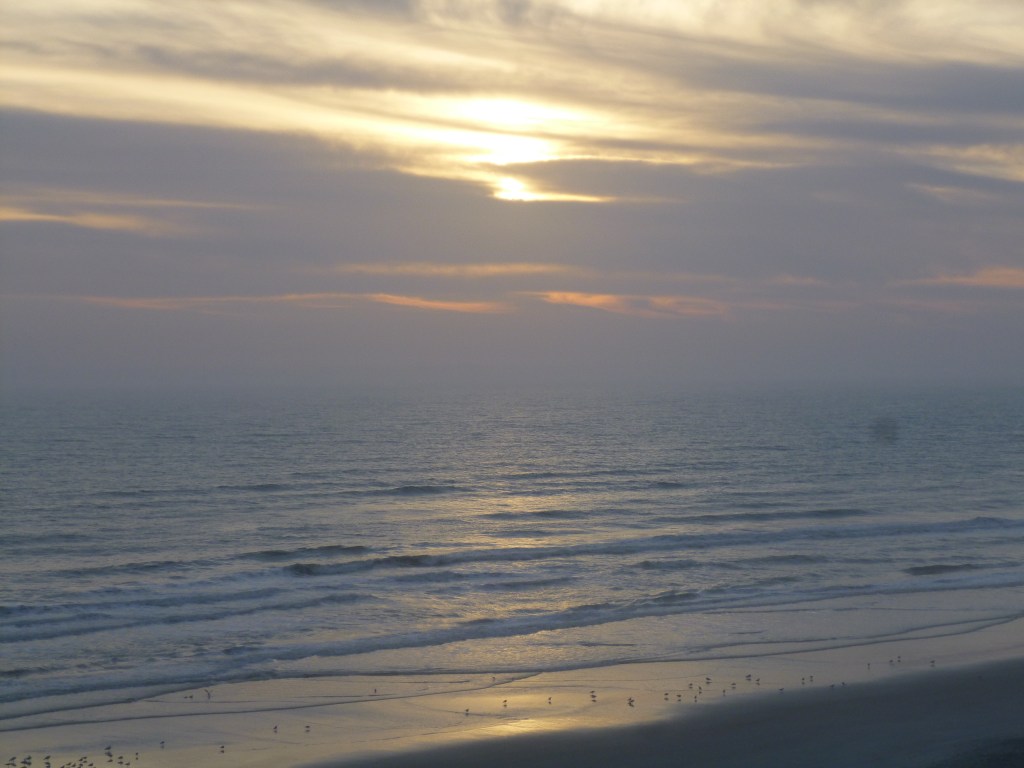
Much of the upcoming Requiem novel, Requiem for Parish, takes place along the beach strip which stretches across the end of Lake Ontario towards Hamilton. When you stand there looking out towards the lake, the beach is featureless. Unless there’s a high wind, the surf is also minimal—not at all like the surge of an ocean. That’s what I mean by the ‘depth’ of an empty page. Your gaze is drawn out towards nothing: an empty horizon. Of course beyond that featureless horizon happens to be the United Staes of America, just about the biggest something on the planet, but in the summer all you see is glare, and in the winter all you see is a hazy emptiness: a blank page, if you will.
It’s not just artists who are seduced by emptiness. The blank page works the same way for writers, although the aesthetic is more complicated. A blank page is a writer’s playground, but it can also be a sullen task master, like one of those bulls on horseback who whip prison labourers. The white page can gang up with a deadline and make your life hell. The only time I’ve experienced that kind of negative pressure was when I was a teacher writing report cards. For me, the blank page still has the same magic as an artist’s canvas primed with glistening white gesso. I can see delightful possibilities there, and all it takes is hours of joyful artistry to make my imagined vision real.
Of course the screen of a tablet or computer can present us with the same dazzling white field as a page of paper, all ready for our creativity. An uncluttered screen works pretty well for writing, drawing you in and along. Mind you, the authors of classic literature had no electronic aids and to fill a page they had to contend with everything from carefully sharpened crow quills to typewriters with clunky keys and ratcheting return bars (look it up).
An American journalist once wrote a column that was ostensibly typed by a cockroach. The cockroach was called Archy, and he laboriously jumped from key to key. I have to admire Archy, overcoming the obstacle of clumsy writing tools to bang out his truth and vision. The cutting edge technology that got me through a hundred college essays was erasable bond paper. Now I know this is a difficult concept for the younger generation, but if you made a mistake on a typewriter back then you had to stop everything and either paint over your mistake with “white-out” paint or start a new page. The new erasable typing paper allowed you to rub out your mistake with a simple eraser.
Speaking of starting over; I’m was amused by a movie in which Shakespeare balls up a piece of paper in frustration and starts over: “the quality of mercy is not…drained? Blamed? Framed?” Paper in Shakespeare’s day was much too expensive and hard to come by to be wasted in this way.
In my first Requiem novel, Requiem for Thursday, I have a character talk about ‘cross writing’. Not so many decades ago writing paper was in short supply, and someone writing a letter could complete a page of tiny careful script and then rotate the pager sideways. Then she would continue writing at right angles to her earlier words. It sounds like it would produce an incredibly dense, illegible letter. In fact if you try it you’ll discover that, if you have to, you can fairly easily follow the overwriting and underwriting.
These days blank pages and blank screens are easily available for us when we want them. I cringe at the thought that we are approaching a new era; one in which we only have to describe our vision out loud to a computer and wait while it ransacks the web, stealing whatever it finds to create a digital image—an image that is something like what we had imagined.
What would happen if I asked an AI program to write a page about blank pages? Perhaps it would write something like I just did. I prefer, though, to think it would run around in circles at the speed of light until the program completely and irrevocably froze.
 Douglas Cockell