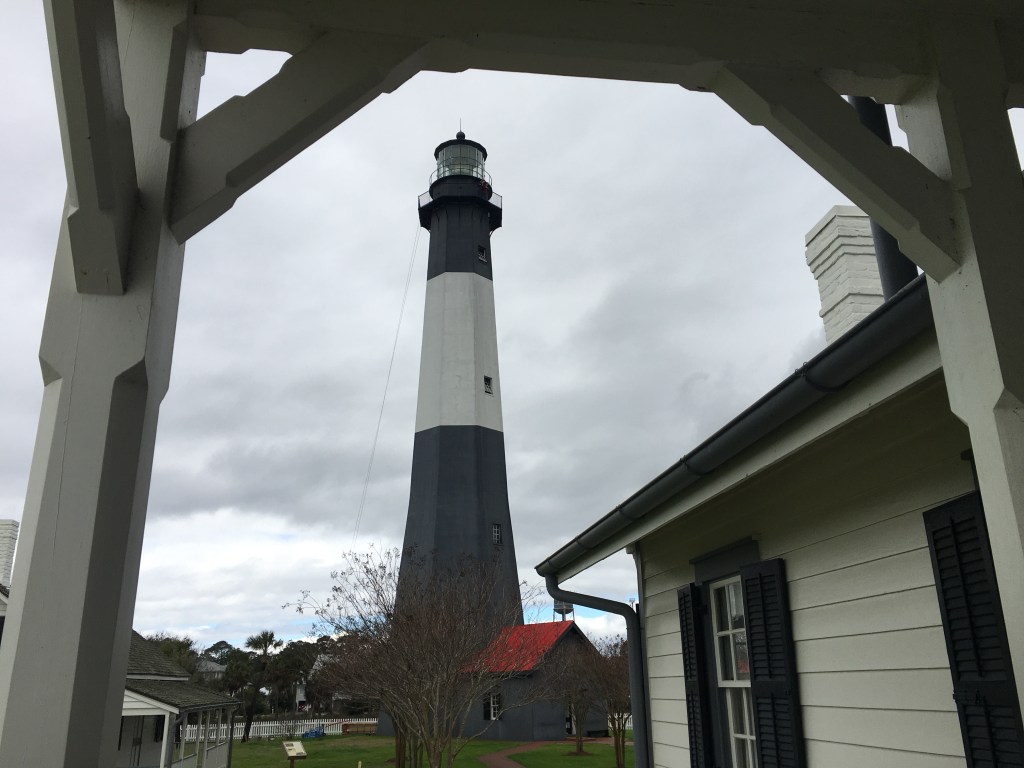
Near the beginning of my novel Requiem for Thursday, Detective Weiss arrives at the Hamilton ship canal to investigate a drowning. Looming over the scene is an old lighthouse—no longer used and no longer lit against the night sky. I imagine him looking up at the old grey stone relic, it’s shape setting the mood almost as powerfully as the bloated body on the pier. It’s not just ships that heed the beckoning of a lighthouse; truth is, a lot of us are drawn to them.
In fact, some of us draw lighthouses. I know I do. As an artist I’ve drawn lighthouses beset by mountainous waves, and quirky ones with resident mermaids. One of my paintings shows a man precariously balanced as he refreshes the paint on the very top of the lamp enclosure, another shows him on an impossibly tall ladder distorted by the lamp housing windows.
As Freud would have said, sometimes a lighthouse is just a lighthouse, but it’s hard to think of a structure more imbued with romance and drama. Ray Bradbury wrote a story called Foghorn, in which he imagined a deep sea monster who falls in love with the plaintive moaning of the light station—which is all very well until the monster is driven to embrace his tall, aloof lover. Bradbury fades the scene to black in the grand tradition of Hollywood sex scenes, but the imagination lingers…
I’ve climbed a few winding staircases and caressed a few fresnel lenses on carefree vacations. Some of the lighthouses were suitably sited near the vastness of the Atlantic, like the St. Augustine tower, but some were annoyingly inland, like the Tybee Island light near Savannah. I suspect the allure of the lighthouse has a lot to do with the great hollow mystery of the ocean itself—for me anyway. I grew up near a sort of fiord off the Atlantic—the Firth of Forth, and I played in the cold but teeming tidal pools on the beaches there. Maybe that saltwater stuff gets in your blood or your spirit and takes up residence for life.
Then there’s genetics. My grandfather was a chief engineer in the merchant navy, and my father was a carpenter who apprenticed on the Clyde shipyards. As a young man, he bought a share in an old whaling skiff and, with friends, he rowed it just for the sheer exhilaration of the waves and the wind.
I don’t really buy the genetics argument, but the influence seeps in in other ways—through tall tales, poems, novels and pictures. Speaking of tall tales, it would be tempting, though hardly original, to write a mystery involving a lighthouse, especially a supernatural mystery. The keening wind and frothing surf would do half the work for me, conjuring up shipwrecked spirits and swimming sirens.
Sirens. Hmm…
Of all the fantasy memes, the siren has to be one of the most compelling: a lovely waif singing from the roiling surf, a song so sweet it draws mariners happily to their death. The trouble is, light stations nowadays are automated and lifeless. There’s no light keeper to fling himself into the sea pools.
What if my heroine Carly were to be the siren herself? She could be unwittingly drawing a self destructive psychopath to her home on the shore of Lake Ontario. Could Carly be a modern siren, broadcasting her powerful spirit through her searching visions, or maybe through her own writing?
That’s the thing about the romance of the past. It demands that we recycle the ancient myths and legends giving them currency and freshness. The truth is, I’ve tried to reframe all my ghost stories, drawing in particular on new scientific notions about the nature of time. After all, each great thought by the ancient story-tellers is an invitation to dream anew.
 Douglas Cockell
Interesting. I’m also drawn to lighthouses and enjoy their inclusion in stories. Well done Doug.
LikeLike