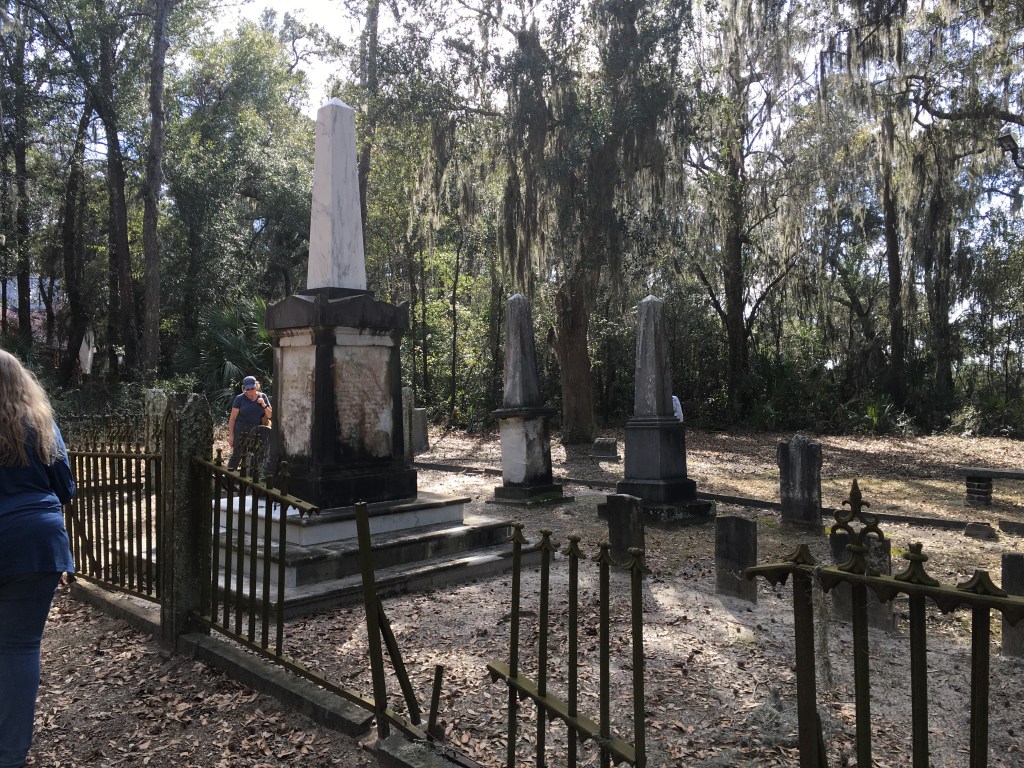
I found myself standing in a graveyard in South Carolina. It was an old burial ground by North American standards, and when these people were interred they were among the very few ethnic Europeans on Hilton Head Island. I imagine you’re thinking of Hilton Head, if you’ve heard of it at all, as a golfer’s and time-share owner’s preserve of the rich or retired, just across that soaring causeway from the mainland, but that’s a fairly recent development. Through most of the preceding centuries it was a remote fringe island, even to the wandering tribes who built seashell mounds around their encampments. Its mosquito-infested obscurity was briefly coloured by pirates and Union army fortifications, but the people interred beneath these rough hewn stones slept in a profound isolation while the mainland began to fill in and prosper. Savannah and Charleston were only a couple of days travel away then, but there was no bridge to the island, and it must have been difficult to navigate a boat over the mix of bog and wetland that defined the shoreline. No romantic tree line across shining waters, mind you—just one swarming weed patch after another, until the shallows became firm enough to walk on.
You have to wonder about these graves: this tall spired monument, that stone block mausoleum. The masons and the very stone blocks themselves must have been ferried here with great difficulty. The money that paid for it mostly came from indigo, an expensive dye exported in compressed blocks to Europe.
I suppose all old burial grounds tell tales of struggle and survival against the social trials of the times. There’s one close to home just off the road into MacTier, a small town in Muskoka. It’s a little field of grass and gravel; barely enough room in which to turn your car, but the tiny markers are inscribed with familiar names: the ancestors of our neighbours. It’s difficult to see a connection between that old graveyard on Hilton Head and this overgrown plot, but when you think about, the opening up of Muskoka was also difficult. Like Hilton Head today, the Muskoka lakes are the modern playground of the rich and privileged, but the people buried here have lain in the same kind of remote isolation for more than a century, until paved roads and freeway bridges brought the affluent masses.
If there’s lesson to be learned here, it’s probably about the debt we owe our forefathers, but honestly what comes to my mind is W.H. Auden’s comment: ‘the past is a strange country where strange people live’. He was warning us against trying to imagine the world in which the people we read about lived. We can’t really conceive of the weight of labour or the terrifying aloneness that defined the lives of these settlers. In one sense, they lived in profound ignorance of the world over their horizon, but in another sense, they were viscerally in touch with the surrounding forest and the local wildlife—in a way we can no longer imagine.
 Douglas Cockell
I love how your mind works, Doug. Your take away from the history tour was so different than mine. Isn’t it wonderful that people have differing thoughts about the same things. Love the blog!
LikeLike
This graveyard is beautiful! The graves are well-made and well-tended. The atmosphere is peaceful and serene. It’s a great place to visit if you’re looking for a peaceful place to rest your soul.
LikeLike