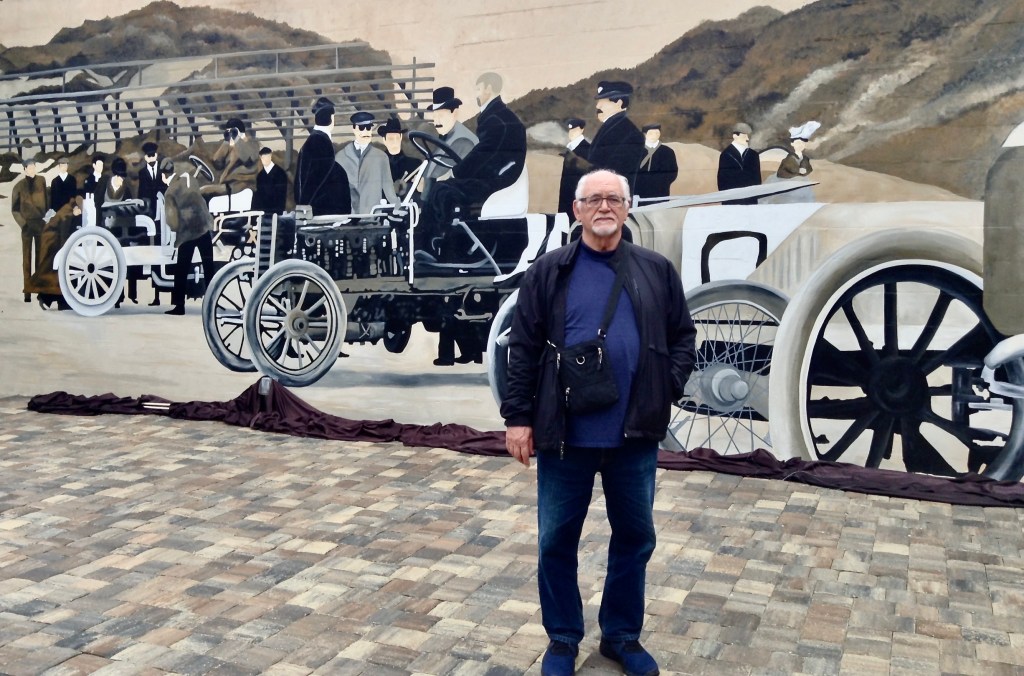
I’m going south to the Daytona Beach area for a few weeks. From St Augustine’s Spanish fort, down to New Smyrna’s lighthouse, it’s a part of Florida that has some history. And some of that history has to do with the heroic pioneers of auto racing. They were the people who were refining cars—and roads for that matter—so that one day I could cruise down I-75 and stop at a Best Western Hotel.
	First you invent the car; then you invent the road. It’s interesting to imagine a time when the streets were laid out for carts and horse traffic. Packed dirt worked fine most of the time. When it rained it got muddy, but nobody was going any faster than a horse trot anyway.
	Then we started to play around with steam or gasoline engines. Nobody thinks much about the innovation of balloon tires, but suddenly the old dusty streets weren’t up to the job. Dirt and mud became the limiting factors in letting these new cars get up to speed.
	Racing was a nice tidy way of comparing these new automobiles, and it offered a brand new sport as well—auto racing. So, where do you race these speedy new machines? There were no suitably paved roads. Hey, look! A stretch of hard beach sand, as smooth as billiard table. Let’s race there!
	Now, I don’t know much about those early machines, or automobiles in general, but they seem to crop up in my art a lot: old trucks and quirky jalopies. As with so many things in my life, I’m caught up in the romance of the era. I have no trouble imagining Glen Curtiss, or Barnie Oldfield, or Louis Chevrolet, roaring down the strand, skirting the surf while spectators in stiff collars and sun hats cheer from the sand dunes. I’ve read E.B. White’s piece on the Model T—Farewell, My Lovely—so I can picture the throbbing power train, the hood strapped down with leather, the long shaft of the steering wheel.
	Some of these early speedsters were driven by a chain mechanism, and I can’t get out of my mind that Isadora Duncan, the lovely popularizer of modern dance, had her neck broken when her long scarf got caught in just such a chain.
	There are probably lots of books about the early race drivers and their oily machines, but somebody ought to write a novel about the period. It should be set in Ormond Beach, just a few minutes up the coast from Daytona, because that’s where it all began—in the Americas at least. The Ormond Garage was where they would get the machines ready, right there within earshot of the Atlantic surf. J D Rockefeller had his winter home, The Casements, just  along the road, and the likes of Malcolm Campbell were walking the dirt streets, bringing their experimental vehicles from all over the western world.
	It would be a story of risk and glory, with dashed dreams and burning wrecks rolling in the shallow tide. And there would be heroes aplenty. Not muscular or tall or sophisticated; these would be men with a technical bent, and a gift for working with their hands, ordinary guys, with maybe a rich sponsor or two. There was money to be had, not just for winning a race along the beach, but for designing a new transmission or streamlining a chassis.
	In imagining his story, the novelist and literary set designer would lean heavily on Art Deco, in which streamlining would dominate everything from architecture to appliances, but many of the early inventors hadn’t actually learned that lesson yet, and their cars would bristle with gaping radiators and flat windscreens.
	Of course, if I were writing the novel there would probably be a murder—a sabotaged car, perhaps—a wealthy widow who loved speed, a detective who knew nothing about cars, and a ghost. A ghost in the machine? Now there’s thought…
 Douglas Cockell