The detective story has endured because it has an inherent story built into it—the uncovering of a mystery through hard work and persistence. It also brings us the eventual triumph of justice over malevolence. While there are traditions that govern setting and character, everything else in the genre is open and available for innovation.
Now, there are readers who don’t want the basics to change much, and I sympathize with this feeling. The world is complicated and untidy; a little familiarity and predictability in a detective story can be satisfying. That’s why we have cosy mysteries in small villages.
There are other readers who think of detective stories as places to go. You pick up a book and you’re transported to some setting with pleasant associations: New Orleans, or New York, or London and so on. Heather Graham comes to mind—I can count on her mysteries to take me to Key West or Salem or a cruise ship. It’s like being on vacation all the time. There are beaches and outdoor cafés.
It’s tempting to be cynical about this reliance on tradition, but I can’t really see anything wrong with providing readers a place to go for imaginative relaxation. After all, there are plenty of authors ready to plumb the spectroscopic range of despair and relentless realism if that’s what you’re looking for.
When my short stories and novels began to lean towards the mystery genre it was natural enough for me to consider a suitably exotic setting. I’ve travelled a bit and I have memories of Newport, Rhode Island; Cape Cod; Louisiana, and Rome among others. And of course, I remember Edinburgh, Scotland where I grew up and where I visit when I can. It doesn’t get much better than Edinburgh for mood and atmosphere, as Ian Rankin and Alistair McCall Smith have proven. I mean, there’s a castle on the main street.
The turning point for me, as I’ve mentioned before, was visiting the haunts of my favorite fictional detective, Dave Robichaux. There I was standing on the bayou in New Iberia, Louisiana luxuriating in the atmosphere: the spanish moss and live oaks, and it struck me: James Lee Burke actually lived here. This was more or less his everyday home.
What Burke had done through dozens of novels was imbue these streets and bridges with a kind of romance that came from within. I saw the same thing in the Lucas Davenport and Virgil Flowers mysteries of John Sanford. He turned Minneapolis and the small towns of Minnesota into a rich ambience. I had no first hand experience of that landscape at all. I got it all from the author; it was his vision.
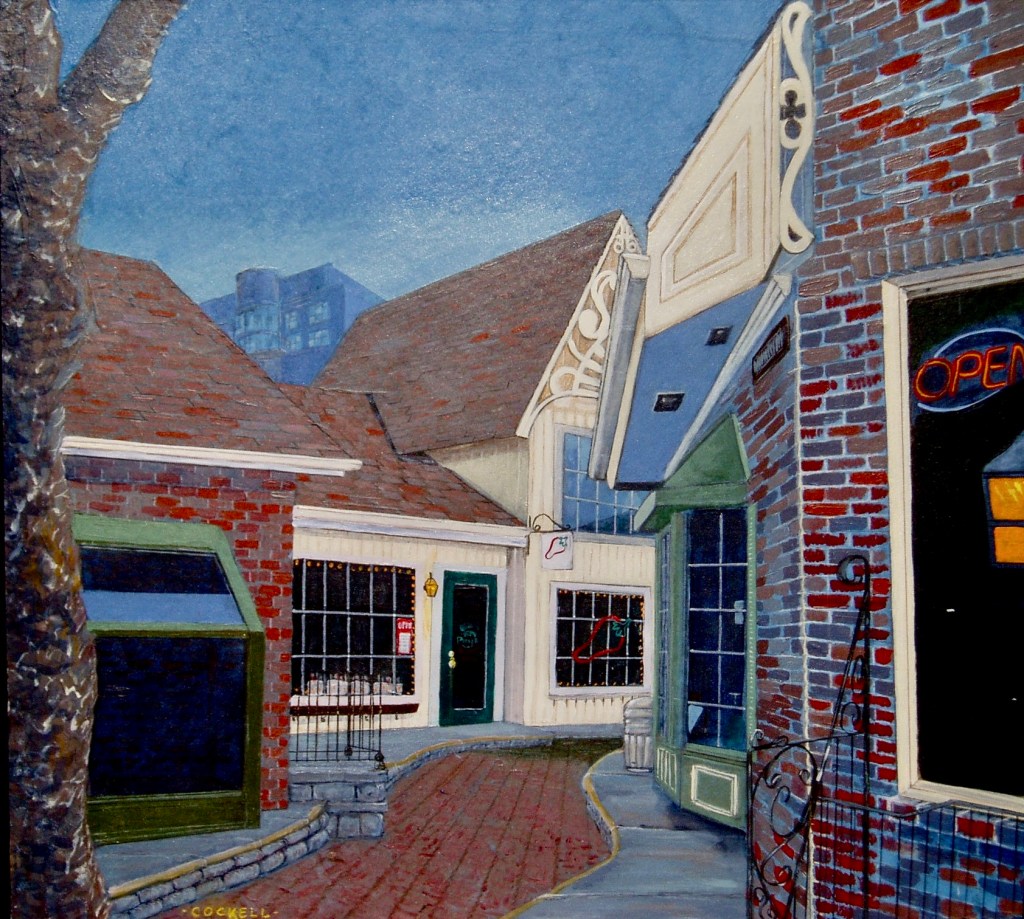
That’s when I began turning my imagination loose on my own city, Burlington, Ontario. Suddenly I saw the lift bridge below the Skyway as charged with power. I saw the looming escarpment for the unique landscape it was. The low rise shops and houses of Brant Street presented themselves as the kernel of a small market town that got big in a hurry.
Fictional detectives are like the rest of us in that they pass through civic centres, cafés and shops. They drive the streets and highways, they visit the town houses and high rises. And they get stuck in traffic.
In Requiem for Parish, the latest Eilert Weiss mystery, Weiss and his partner Prem Joshi are forced to languish in their car in summer heat while the vehicles around them crawl and stop dead. It’s a very specific highway I had in mind: the Queen Elizabeth Way, one of the busiest in North America, and stop and go traffic is one of the peculiarities of living where I do. I realized that Weiss’s car would suddenly become his office as he worked his phone. Rather than bringing the story to a stand still, the front seat of the car provided one of the seminal scenes in the novel. Weiss and Joshi might have been getting nowhere in their car, but their inquiries were continuing, booming over the car’s speaker system, and that scene provides the basis for the investigation that follows.
It will be interesting to see if I can put you in that car, and in that traffic jam.
 Douglas Cockell
As a short story writer, reading this post has brought me to tears. It reminds me of the power of storytelling and how it can transport readers to places they’ve never been, and make them fall in love with places they thought they knew. The idea that a setting can be imbued with a kind of romance that comes from within, as James Lee Burke did with New Iberia, Louisiana, is truly inspiring. This post has reminded me of the importance of using my imagination and my own experiences to bring my own city, Cumbaya, Ecuador, to life in my writing. I am so grateful to have read this and it has reignited my passion for writing. Thank you for sharing your thoughts and experiences, Douglas Cockell.
LikeLike