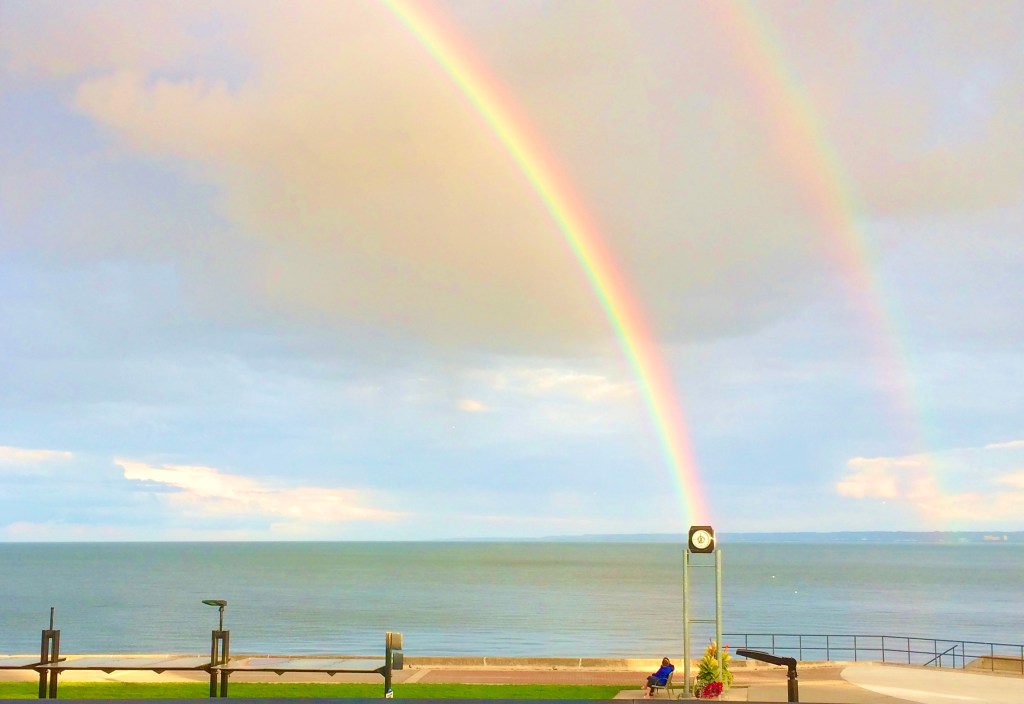
Spectrum January 10, 2023January 10, 2023 / douglascockell Sometime when I wasn’t paying too much attention we entered the era of the spectrum. I should have noticed. Einstein’s vision of reality showed us that you can turn a little bit of dirt into enough energy to fuse sand into glass. If you don’t believe me, here’s the math on the chalkboard. E=mC2. How tidy!And then along comes quantum theory and everything is probabilities. Yeah sure, light is made up of particles—except of course when it’s a wave. The cat in Schroedinger’s box is alive, except, of course when it’s dead. Maybe the poor cat is on a spectrum between life and death. It all depends on which way the needle swings. One thing is for sure, he’ll think twice before climbing into a box again. Speaking of boxes, we used to be able to tick off a box: M or F. Now we realize that there are people who live fabulously in between the two; maybe a 7 on the scale of 10. Maybe Walmart will rename a department: ‘People’s Intimates’. And I thought their layout was already confusing. In politics people are distributed along the scale from right wing to left, with plenty of us twitching anxiously somewhere in the middle, afraid of what the folks at either end will do next. It’s like living in an apartment beneath a terrorist cell and above a bomb maker. Recently there has been a grumpy shuffling towards each political extreme, making it increasingly difficult for us to talk to one another, but the spectrum is still there.Literature is like that—on a spectrum, I mean. Take poetry. The poetry of D.H. Lawrence is so spare and conversational that one of his poems was stuck into the script of a movie once—without anyone noticing: someone at the dinner table just starts talking. “The correct way to eat a fig in society is to…” The talker goes on for a couple of minutes, stops, and there’s a momentary silence. Everyone is slightly embarrassed because all that stuff about “bivalve roundness” sounds vaguely like sexual innuendo. But then the conversations resumes and the poem is officially subsumed into the surrounding chatter. In other words, the poem was very close to normal speech patterns. On the opposite end of the poetry spectrum would be someone like Dylan Thomas. Critics would refer to him as word drunk. Mind you he was often drunk drunk too, but not while he was writing. He would wail, as though from a boozy pulpit,“Time held me green and dying, though I sang in my chains like the sea.” Oh-kay… Start spouting that stuff at a party and people will stare and edge away. The spectrum in poetry is between spare naturalness and verbal indulgence. In fiction I think of Earnest Hemingway at one end of the spectrum. I read that he would stare at the typewriter until little beads of blood formed on his forehead, trying to find just the right word. But when he found it, it was a simple word, and the sentence would wind up being short, direct, and pure. It was his journalistic training they say. Hemingway liked to think of himself as rough and manly, and his ideal of the written word was correspondingly lean and unembellished. He would hate that word’ unembellished’. Come to think of it, so do I, but I can’t be bothered to go back and change it. On the other end of the fiction spectrum I think of Scott Fitzgerald. People like to pick out passages of his writing and read them out loud just to revel in the luscious prose. The trouble with poetic prose is that it can slow the reader and drag the story down. If you do it in moderation, it can add atmosphere and mood to a story. If you get carried away, readers can look up and mumble, “So who was murdered again?”There are some readers who have the patience for decorous writing, recognize it and admire it. It’s what drew me immediately to the mysteries of James Lee Burke. I felt a kinship with his obvious love of the English language, but in his stories, I always knew who had been tossed in the bayou.English is a hybrid language, a mix of Latin and Germanic roots. Gerard Manley Hopkins, an Irish Catholic priest at the turn of the twentieth century, recognized that the Latinate words in English tended to have many syllables and sound grandiose. The Germanic Anglo-Saxon words were curt and direct. Hopkins chose to write his poems relying mostly on these short gritty nouns and verbs. “Margaret are you grieving over Goldengrove unleaving?” It made his poems stand out against the background of elaborate pastoral and heroic verse in which the poets seemed to be showing off their private school classicism. Nobody would call Hopkins simple, but he seems a spectrum away from Tennyson.When we were young we imagined the world was made up of right and wrong, good and evil. We could tell the villain by the colour of his cowboy hat. Now, if we have the courage, we acknowledge that often the truth can at best be a point on a spectrum. Sometimes there doesn’t even seem to be a fixed point at all and we’re forced to choose a sort of fuzzy probability on the scale from right to wrong. When we do that, I hope we’re guided by compassion and logic in equal measure. A friend of mine once took a course in philosophy because it was mandatory. She still shudders at the memory of discussing “What Is Truth?” Does she wake her husband in the middle of the night, grab his Denver Hays night shirt and shout, “But can we ever truly know?” To which, the only possible answer is, “It’s all right dear. Go back to sleep.”In writing my own fiction, I find myself dealing with spectra. Like Edgar Allen Poe, I hint that life and death can become blurred, and past and present can co-exist. We use to be able to say that such ideas were unscientific, but modern physics and cosmology seem to allow that it’s all question of how closely you look. Share this: Share on Facebook (Opens in new window) Facebook Share on X (Opens in new window) X Share on Reddit (Opens in new window) Reddit Print (Opens in new window) Print Email a link to a friend (Opens in new window) Email Related
 Douglas Cockell