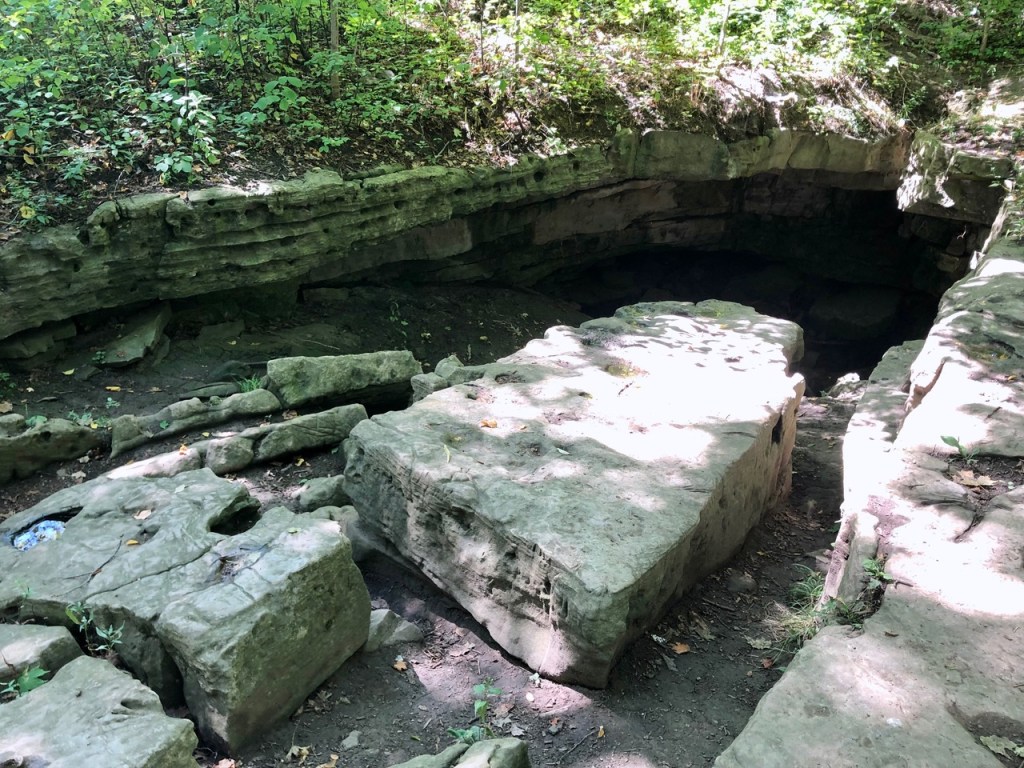
Conversation between Detective Prem Joshi and Deputy Superintendent Filman:
Joshi: “This time he dumped the body in a karst.”
Filman: “What’s a karst? Wait. Is this the setup for a joke?”
Joshi: “No, no! Let me have my moment. I’ve been waiting weeks for someone to ask me what a karst is. It’s a geographic feature, kind of like a cave. More like a split in the limestone. There’s a conservation area in Hamilton: the Eramosa Karst.”
I was there recently and I took pictures. So there I was, in a lovely late summer forest surrounded by ancient trees and berried bushes. It was a beautiful day with blue sky and shady pathways, and I was thinking to myself, ‘What a great place to dump a body.’
I’m a kind person, good with children and house pets, and yet I’m thinking about disposing of a corpse. It’s like there’s a disconnect between my civilized self and my story-telling self. I know I’m not alone here; murder mysteries are a widely popular genre. People love a brazen murder—good people who water their lawns and pay taxes.
Sure, there are sub-genres within mysteries that cater to a genteel clientele. These readers want their murders tidy and bloodless. Their killer is, perhaps, a sexton of the local church who briefly lost his temper and clubbed the parson with a bottle of holy water. He feels terrible about it, and is almost relieved when the choir mistress uncovers his guilt by finding a tiny spec of blood. On a doily. Guys like him often don’t bother with disposing of the body. They just go home and, over tea and cucumber sandwiches, they fret.
I’ve found out I don’t write those kinds of mysteries. In fact I’m wondering if some part of me is seriously bent. In writing the Requiem series, I’ve found myself repeatedly trying to enter the mind of a killer. And it’s different every time.
There are murderers who are horrified by what they’re planning to do. With difficulty, they find the courage to carry a gun or push down hard on a pillow.
And then there are the psychopaths who revel in their selfish cruelty. These crazies sometimes stage the bodies as a final act of bravado. Or they might get rid of the evidence, weighting it down and sinking it in a swamp, confident that they’ll never be caught.
In one of my books the villain murders as one would swat a mosquito.
No. Bad comparison; that would be self-defence, wouldn’t it? I myself harbour deep feelings of murderous resentment towards mosquitoes. I bought a bright blue light that incinerates them with a satisfying zap. I sleep well and have no regrets.
The point is, there are killers who commit acts of violence with cold hearted ease.
In recent years, though, we’ve been trained to see that dysfunctional personalities exist on a spectrum. What if the murderer is, say, a four on the mayhem scale? I’m scratching my head over just such a paradox. What if the killer wants the bodies to be found—just not too quickly? What if the perp’s own capture and punishment are part of the plan?
That would be a peculiar type of villain. The killer’s not a sadist, but s/he mutilates the bodies of the victims following some twisted sense of personal need. The killer rolls the body into a karst, (see above) where it will be discovered by the first intrepid geo-hiker with a smart phone.
The one constant in the mystery genre seems to be selfishness. To take another life, the most squeamish murderer must, in the final analysis, be self-absorbed.
If you write crime fiction, inhabiting the mind of a killer is part of the job description, but there is solace in one thing. You also find yourself taking on the role of justice-seeker. Carly Rouhl and Detective Eilert Weiss have slightly different roles in the Requiem novels, but each in turn becomes the advocate of the deceased. They restore order in a moral universe that has, for the moment, been wrenched out of joint. But to do so, they have to take a long, hard look into the karst.
 Douglas Cockell