I drew a cartoon once: There’s a lovely maiden sitting under a tree and a young swain is kneeling beside her with his hand on his heart. The girl says, “So you can write poetry. You’re still a Goddamed shepherd.” I’d been reading pastoral poems with their delicate idylls of love and simplicity, but I suppose even then I was thinking about the gulf between the romantic and the socially honest.
I used to do a slide talk on Route 66. It was an art series and I’d show pictures of Googie architecture and classic cars—that sort of thing. The real focus of the talk though was nostalgia, something that underlies much of my writing and some of my art. I’ve driven stretches of Route 66 and it’s generally a place where old gas stations go to die, stark and depressed—and yet it lives on in the imagination. Folk as far away as Germany grow misty-eyed thinking about it, as though it was a sort of Autobahn with attitude.
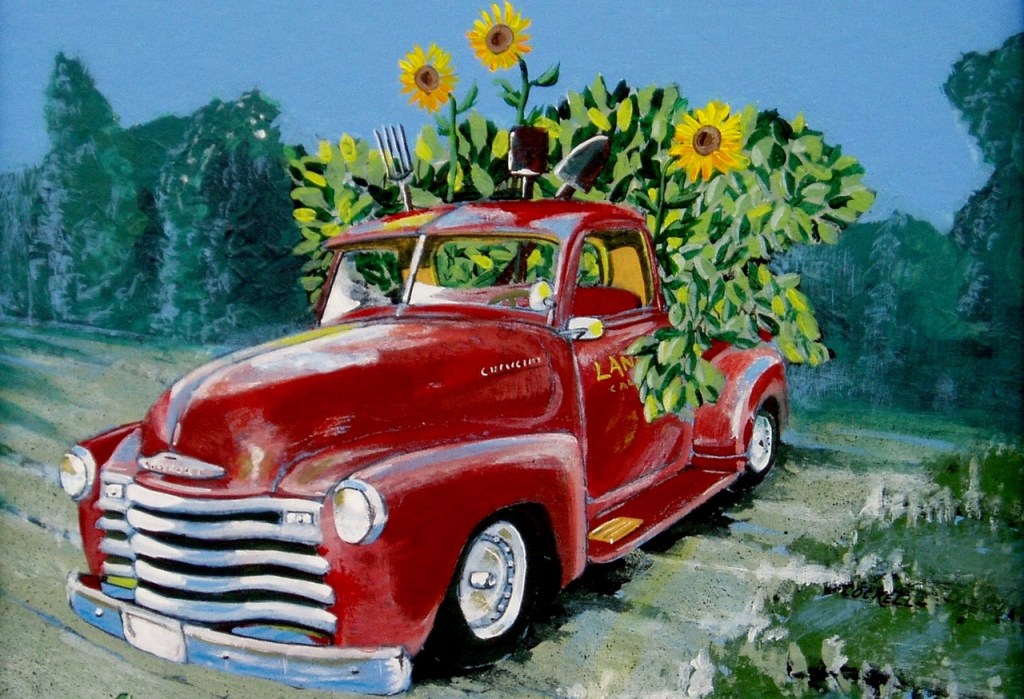
There’s a kernel of historic importance there, of course: for the first time in America there were highways and cars capable of opening up the country to middle class suburbanites, and they had the money and leisure to take advantage of it. You could ‘See the USA in your Chevrolet’, but that historic post-war nexus has become romanticized, and inevitably commercialized. I have a tin Route 66 sign nailed up in my studio.
I’m currently writing a novel about a couple who were ‘pickers’: collectors of Americana. They once owned a shop selling everything from ‘Rock-ola’ juke boxes to the frame of an old Indian motorbike; drug store lamps, metal advertising signs, band stands and a pianola… The husband has passed away and the wife has the remains of their inventory stored away in her basement against the day she can have a final auction. Ah, that corner of the basement packed to the ceiling tiles with mid-century icons! What a perfect portal to the past. A man could get lost in there—or a woman like Carly Rouhl, the pivotal character in my Requiem novels, who has trouble sorting out the difference between creative imagination and visionary hallucination.
In my art talk about Route 66 I was careful to acknowledge that nostalgia can be a danger; after all it was first identified as a disease afflicting German troops fighting far from home. I’ve noticed that some people are embarrassed to admit their love of Norman Rockwell paintings because Rockwell is synonymous with uncritical admiration for an America that existed for a lucky few if it ever existed at all. That seems a shame. The guy was good, and his heart seemed to be in the right place. I read his autobiography, ghosted by his son, and found Rockwell to be congenial company. I don’t doubt he was as screwed up as the rest of us in ways that didn’t make it into the book, but I don’t feel I was lied to.
There’s a sci fi writer you may remember, Jack Finney, who wrote from a deep nostalgic longing. Like me, he was obsessed with time and wrote several time travel tales. Finney’s The Invasion of the Body Snatchers was originally inspired by what he perceived as a loss of character in America’s small towns. The townsfolk are replaced, one by one, by emotionless pod people. At the time of the movie adaptation, the cold war era audience was preoccupied by alien invasion, which was a surrogate for nuclear war, but the real enemy for Finney was modern soullessness.
What’s happening now, of course, is that nostalgia is running up against a new awareness of our troubled, unjust past. If we use nostalgia to paper over ugly realities that’s wrong; if we use it to withdraw, however briefly from the clamouring insanity of our present society, maybe that’s just therapy. Thomas Hardy said, “If a way to the better there be, it exacts a full look at the worst”. Let’s engage the unfairness of our society and embrace constructive change.
But let’s not lose our vision of our own congenial ideal, whatever that might be.
We can indulge our soft-focus imagination now and then. There are after all plenty of writers and artists, bless them, who feel compelled to tell the stories of the poor and exploited. But this vague longing for a rich and simple past when gas prices were low and diners cheap can be gulped like a mildly addictive drug—if you’re worldly enough to vote with your social conscience and not with your prejudices.
At some level, art entertains. It can do other things, of course, like speak for the victims of injustice and reflect our times back at us. And sometimes the longing for escape to somewhere less vexing speaks volumes about the world in which we find ourselves.
 Douglas Cockell
Yes indeed, Route 66 conjures up so much imagery steeped in history and mythology even though it is nothing more than a poorly maintained road with lots of potholes. And that is one way of looking at it. But to ride its surface, navigate its curves, and not think about art or history or the dollar exchange rate, or wife, kids and dogs, while seated, low, hard, secure on a Harley Davidson, well that’s a whole other conversation, Doug.
LikeLike