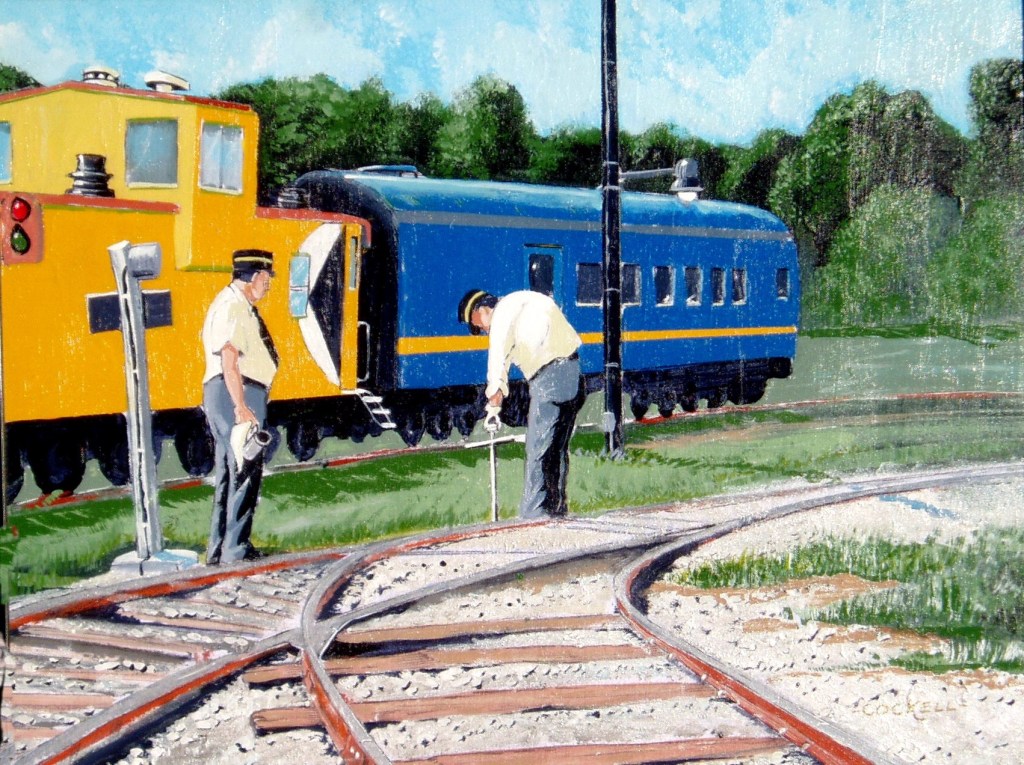
The CN and CP tracks run parallel and close together here on the MacTier sideroad. As I approach the first track the red warning lights start to flash and I pull up far enough back to get a good view of the train as it crosses the road ahead. There’s a wail from somewhere in the forest to my left—the same wail that sounds so ghostly echoing across the lake at night, and then the diesel, red and blocky, rumbles past. I shut off the car engine and idly start to count. The containers are mounted two high, the cylindrical petroleum carriages long and black, embroidered with white spray paint.
My mind wanders, and for the flimsiest of reasons, it jumps to James Thurber, America’s second greatest humourist (after Mark Twain)—Thurber and a friend on a train in France. It’s the Thirties and they are stopping at people’s seats to ask a question: When Edgar Allen Poe’s Raven croaks his immortal word, is it better in French or English? ‘Nevermore’, or ‘Jamais plus’? It must have been a compelling question on that train, long ago, now it’s just a happy memory to this guy sitting in a car waiting for a very long train to pass.
I picture, with the clarity some people remember a great play in baseball, sitting in a Tim Horton’s on my way back from a day’s work. It must be thirty years ago and I’m reading a well thumbed paperback of A Thurber Carnival, an anthology of his short pieces. They’re whimsical and often funny, and I’m enthralled. Thurber was the start of a long list of readings from and about New York in the twenties and thirties: The Algonquin Circle, F. Scott Fitzgerald, the Shubert Brothers… It’s a list as long as that train out there, and like the train, it’s not yet passed me by.
What’s interesting about this daydream is that it represents a path in my life—one of many. I became interested in humourists and satirists. It led me to become a painter of whimsical art, and to write two, yet to be published, satiric novels: Bagelwarp and Selling Eden. But like a fork in a railway track, this path gave way to a darker and more sinister road. Here I am writing a fourth mystery novel that touches on a ghostly past—a past that simply won’t stay dead and gone.
That train out there, still rumbling, will pass through MacTier in a few minutes. Yesterday it was crossing the prairies. The day before that it was being assembled in Vancouver by some guy who had to work out weights and locomotive power and the placement of hazardous freight.
Midway through the long train, a second diesel engine helps bear the load, this one mute, the ghostly wail unnecessary. I count 150 carriages rolling past my windshield. There’s a rhythm to the sight, and it’s calming. Thunder isn’t supposed to sooth the mind, but this steady grind of steel on steel could be a waterfall. In fact it sounds just like the rapids at Bala. The last of the rolling stock rides out of the forest, shambles past me, and plunges back into the trees again to my right.
Then, at last, a silence. There is no one behind me, and no car on the other side of the tracks. The red lights stop flashing. There is no bar to swing upward, just the empty road ahead. This show, this little performance on an iron stage, this carnival of commodities, has been for me alone.
I start my engine, bump across the rails and resume my journey.
 Douglas Cockell